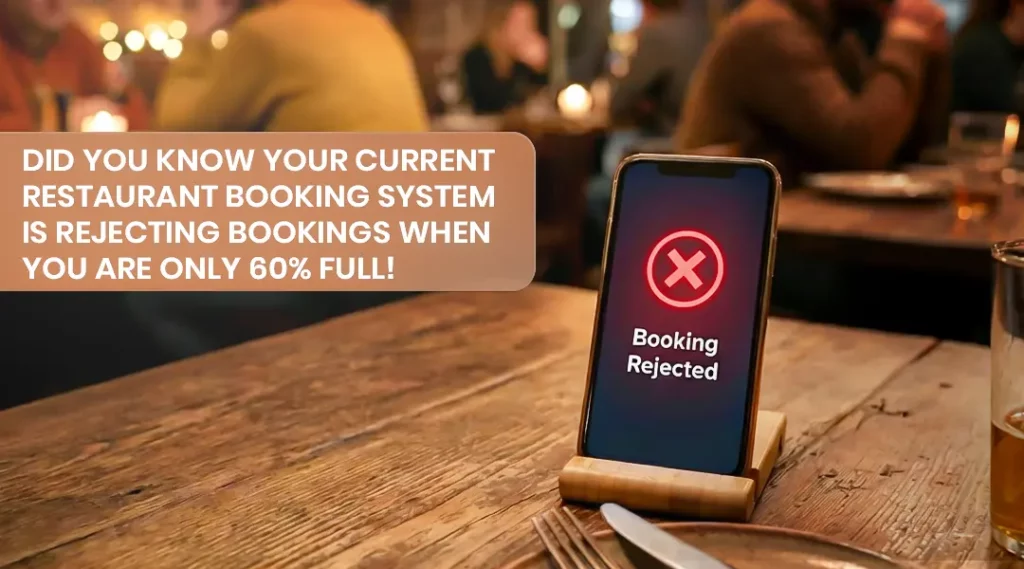
Why does my restaurant show “no availability” when tables are empty?
It is a common situation. A guest tries to book online and sees “no availability.” Later, they call the restaurant, and the staff finds space without much trouble.
This raises a simple question. If the restaurant is not full, why are bookings getting rejected?
In many cases, the issue is not demand. It is how the restaurant operating system works.
What happens when a booking gets rejected?
When a system shows “no availability,” most guests do not try again. They move on and book somewhere else. This means the restaurant is not just losing a booking. It is losing a guest who was ready to spend.
Many operators do not even see these rejected requests. There is no clear alert, no report, and no insight into how often this happens.
How do restaurant booking systems actually work?
Most booking systems are built around tables. Each table has a fixed size, and the system tries to match bookings to those tables. If a guest requests a table for six, the system looks for:
- A table for six
- Or a combination of tables that fit exactly
If it cannot find a clean match, it rejects the request. This process works well when the restaurant is mostly empty. But as bookings increase, the layout becomes harder to manage.
Why do booking systems start failing around 60% capacity?
As more reservations come in, the system fills tables in a fixed way. Over time, this creates gaps that are hard to use. For example:
- A table for four may be booked by two guests
- Two tables for two may be placed far apart
- A large table may be blocked by smaller bookings
At this point, the system struggles to fit new requests, even when space still exists. This is why many restaurants see rejections when they are only 60 to 70 percent full.
Why can staff accept bookings that the system rejects?
A manager or host does not think in fixed tables. They look at the whole floor. They may:
- Shift a booking by 15 minutes
- Combine or split tables
- Rearrange seating based on real conditions
This kind of decision requires flexibility. Most systems do not have that level of control.
How much revenue is lost due to rejected bookings?
The impact is often larger than expected. If a restaurant booking system rejects just a few bookings, it costs thousands, every week. A simple example:
- 3 small group bookings and 1 larger group per week
- Around 25 to 30 guests lost
- Average spend per guest
Over a year, this can result in a significant amount of missed revenue. The key point is this. These are not random losses. These are guests who already tried to book.
Why don’t booking systems alert restaurants about rejections?
Most restaurant booking systems are designed to track what gets confirmed, not what gets missed. Their core focus is on managing accepted reservations, table assignments, and guest details. As a result, rejected booking attempts often remain invisible within the system.
When a guest tries to book and the system shows “no availability,” that interaction usually ends there. The system does not treat it as meaningful data. It does not log the attempt in a way that helps the restaurant understand what just happened. This creates a gap where real demand exists, but it is never fully captured or analyzed.
Over time, this leads to a lack of clarity. Restaurants cannot easily see how many guests attempted to book during peak hours, which group sizes faced the most rejection, or whether those requests could have been accommodated with minor adjustments. Without this level of insight, operators are left with an incomplete picture of their business.
This also affects decision-making. If a restaurant only sees confirmed bookings, it may assume that demand is lower than it actually is. In reality, there may be a steady flow of guests being turned away by the system without the team ever knowing.
Without visibility into rejected requests, it becomes difficult to measure true demand, identify patterns, or improve booking acceptance. The system appears to be working as expected, while quietly limiting the restaurant’s ability to capture more guests.
What should a modern restaurant booking system do differently?
A dynamic realtime restaurant booking system should look beyond fixed tables. It should focus on the full space and how it changes over time. It should be able to:
- Adjust layouts based on demand
- Consider time, not just table size
- Allow more flexible allocation of guests
The goal is simple. Accept more valid bookings without creating operational issues.
How can restaurants reduce booking rejections?
There are a few practical steps to consider:
- Review how often bookings are rejected
- Check if certain group sizes face more issues
- Look at how tables are assigned during peak hours
Even small changes in layout or timing can improve acceptance rates.
A different approach to restaurant bookings
Some newer systems are moving away from table-based logic. They focus on managing the entire space in real time rather than fixed table combinations.
WizButler patented booking system is one example of this approach. It models the restaurant as a dynamic space instead of a set of static tables. This allows more flexibility in how bookings are handled, especially during busy periods.
Summary
If your restaurant appears full online while still having empty tables, the issue may not be demand. It may be the way your booking system is designed.
Understanding how these systems work is the first step. From there, it becomes easier to identify where revenue is being lost and how to improve booking performance.