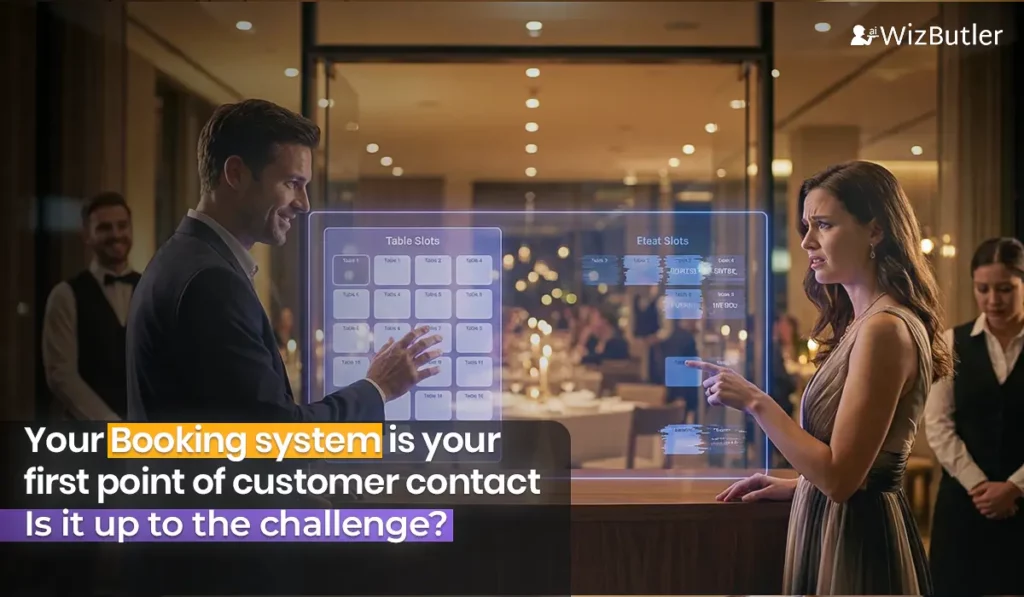
Your restaurant booking system is more than a reservation tool.
It is your first point of customer contact.
Before a guest experiences your food, service, or atmosphere, they experience your system. That first interaction shapes whether they book, call, return, or move on.
If your booking system is not as good as your best staff member, it is costing you revenue.
Your Booking System Is Your Window to the World
For many venues, the first customer interaction happens through:
- the online booking widget
- a phone enquiry
- a reservation confirmation
- a change request
- a function or event enquiry
This means your booking system is not just operational software. It is part of your sales process, your customer experience, and your brand.
A strong restaurant communication system should do more than capture a reservation. It should help your venue convert demand, personalise the guest experience, and support staff in real time.
Why the First Customer Interaction Matters So Much
The first interaction sets the tone for everything that follows.
If the experience is smooth, intelligent, and responsive, the customer feels confidence.
If it is rigid, slow, or inaccurate, the customer feels friction.
The First Point of Contact Influences Revenue
Your first point of contact affects:
- whether the customer books at all
- whether a call is answered or missed
- whether a VIP is recognised
- whether availability is shown accurately
- whether your team has the information they need
This is why customer interaction in restaurants is not just about hospitality at the table. It begins the moment a customer tries to engage with your venue.
If Your System Is Not as Good as Your Staff, You Are Losing Money
Ask yourself:
Can your booking system:
- rearrange existing bookings to maximise the number of bookings taken?
- seat a VIP on their favourite table?
- recognise customer history in real time?
- optimise availability dynamically instead of rejecting demand?
If not, your system is underperforming your staff.
In many restaurants, staff compensate for weak systems every day. They manually shift bookings, override allocations, answer missed enquiries, and update disconnected tools just to keep service running properly.
That is not efficiency. That is hidden operational drag.
The Cost of Missed Calls in Restaurants
One of the biggest hidden leaks in hospitality is poor restaurant call handling.
During busy service, staff often cannot answer every phone call. That leads to:
- missed bookings
- lost function enquiries
- frustrated customers
- inconsistent service
- reduced conversion from demand
Missed Calls Mean Missed Revenue
A missed call in a restaurant is not just an inconvenience. It can mean:
- a table not booked
- a private dining enquiry lost
- a high-value customer choosing another venue
- a negative first impression
This is why many venues are now exploring an AI receptionist for restaurants or a voice AI restaurant solution to handle enquiries consistently and capture demand 24/7.
But handling calls alone does not solve the full problem if the underlying booking logic is still static.
The Real Problem Is the Table Framework
Most restaurant systems are built on a table framework.
That means they rely on:
- fixed tables
- fixed floor plans
- fixed table combinations
- fixed allocations each time a booking is received
The problem is that restaurants are not static environments.
They are dynamic spaces where bookings shift, tables move, customers change, and services evolve in real time.
Static Systems Struggle in Dynamic Restaurants
When static systems are used in dynamic venues, the result is often:
- unnecessary booking rejections
- manual overrides
- repetitive staff tasks
- poor guest personalisation
- lost revenue during busy service
This is why some restaurants appear full online while still having unused capacity in reality.
Why Staff Should Not Be the Glue Holding Systems Together
Many venues operate with multiple disconnected systems across:
- bookings
- functions
- ordering
- POS
- marketing
- customer data
Staff then become the glue that keeps everything together.
They update one system after another, patch over incomplete integrations, and manually correct problems that the technology should solve on its own.
Repetitive Manual Tasks Hurt Customer Experience
When staff spend their time on:
- manual overrides
- repetitive data entry
- fixing allocation problems
- updating fragmented systems
they have less time to focus on:
- customer experience in hospitality
- personalised service
- upselling opportunities
- smoother operations
Your system should support your staff, not rely on them to make it work.
The Shift from Tables to Space & Time
To improve the first point of contact, restaurants need more than another booking tool.
They need a different framework.
A Space & Time system treats the restaurant as a dynamic operating environment, not a static table map.
Instead of being limited by fixed table logic, it manages:
- space availability
- time availability
- customer preferences
- booking optimisation in real time
What a Space & Time System Makes Possible
A more intelligent system can enable:
- autonomous real-time booking optimisation
- autonomous customer personalisation
- better utilisation of capacity
- fewer manual interventions
- stronger guest experience optimisation
This means the booking system can become as good as your best staff member, and in some cases, even more consistent.
What Better Customer Interaction Looks Like
When the first point of contact is intelligent, the whole venue performs better.
Autonomous Customer Personalisation
A modern system should be able to:
- recognise returning guests
- seat VIPs at preferred tables
- apply customer knowledge in real time
- create a more personalised experience from the beginning
Autonomous Real-Time Booking Optimisation
A modern system should also be able to:
- rearrange bookings dynamically
- reveal hidden capacity
- accept more viable reservations
- reduce unnecessary rejections
Better Communication Across Every Channel
A stronger restaurant communication system can improve:
- online reservations
- phone enquiries
- guest follow-up
- internal visibility for staff
Combined with tools such as voice AI for restaurants or an AI receptionist for restaurants, venues can improve responsiveness without increasing manual workload.
Why This Defines Restaurant Revenue
The first point of contact determines how effectively your venue converts demand into revenue.
If your system:
- misses calls
- rejects viable bookings
- fails to recognise guests
- depends on staff to fix it constantly
then it is limiting both revenue and customer experience.
If your system:
- captures every enquiry
- optimises bookings in real time
- personalises guest interactions
- gives staff a single source of truth
then it becomes a revenue driver.
That is why your first point of contact does not just influence operations.
It defines restaurant revenue.
WizButler Is More Than a Booking System
WizButler is not just a dynamic booking system.
It is a Space & Time Revenue Operating System designed to help restaurants move beyond static table-based frameworks.
It is built to support:
- autonomous customer personalisation
- autonomous real-time booking optimisation
- reduced manual repetitive tasks
- a stronger first point of customer contact
When your system understands the customer, the space, and time in real time, your venue can operate with more intelligence, more clarity, and more revenue potential.
Apply for a Space & Time Diagnosis
If your staff are still doing the work your system should be doing, it may be time to rethink your first point of contact.
Apply for a Space & Time Diagnosis to uncover:
- hidden capacity
- lost booking opportunities
- friction in your customer journey
- the revenue cost of static systems
Put your customer first.
Because the quality of your first point of contact shapes everything that follows.
