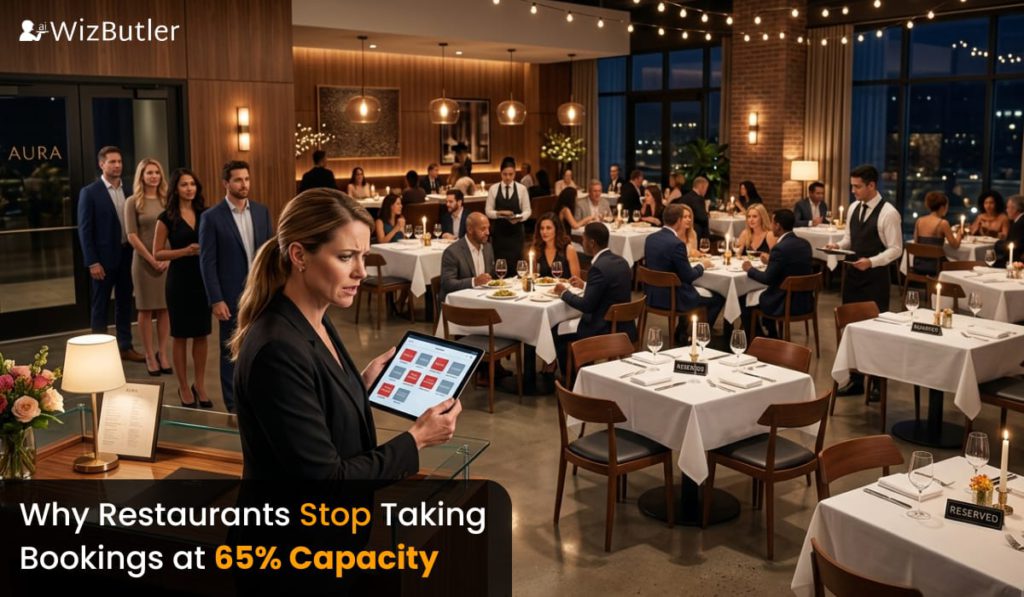
Most restaurant booking systems are built around fixed tables, table combinations, and pre-set allocation rules. As a result, they can reject new online bookings even when up to 35% of the restaurant remains empty.
The problem is not a lack of space. The problem is how the system allocates bookings.
While many booking platforms claim they optimize reservations, they cannot truly optimize when a new booking request arrives. Real optimization must happen at the exact moment a guest tries to book. Instead, these systems rely on table allocations that were defined in advance.
Why Predefined Allocations Are Not Optimization
To maximize bookings, a system would need to evaluate every new reservation request against the restaurant’s current operating state.
Traditional booking systems cannot do this.
They depend on fixed tables and predefined table combinations created before service begins. These allocations are based on assumptions about future bookings, guest numbers, and arrival patterns.
But future bookings are unknown.
A system cannot accurately predict what size bookings will arrive next or when they will be made. Creating allocation rules in advance is simply making a guess. A guess is not an optimization.
Restaurants need optimization based on reality, not assumptions.
The Gap Between Booking Systems and Real Operations
Restaurants are constantly changing throughout service.
Tables can be joined together.
Tables can be moved.
Bookings can be rearranged.
VIP guests may need specific seating.
Available space can be used in different ways depending on demand.
These are normal operational decisions made every day by experienced managers. However, most booking systems cannot account for these real-world adjustments because they are restricted by static table structures.
What Should Happen When a New Booking Request Arrives
When a guest submits a booking request, the system should evaluate the entire venue in real time.
It should be able to reallocate existing bookings, rearrange table configurations, optimize available space, and find the best possible solution before rejecting the reservation.
Instead, most systems simply check whether the request fits within a predefined allocation. If it does not, the booking is rejected, even when the restaurant still has capacity.
Calculate How Much Revenue You’re Losing
Most restaurants never see the true cost of rejected bookings.
A booking system may reject guests because of allocation rules, not because the restaurant is actually full. Every rejected booking represents lost revenue, lost guest data, and potentially lost repeat business.
Want to know how much these rejections are costing your restaurant?
Use our Restaurant Revenue Loss Calculator to estimate the revenue impact of rejected bookings and discover how much additional revenue could be captured with a system designed to optimize real space instead of static tables.
Calculate your potential revenue loss today and see what your current booking system may be costing you.
Conclusion
This is not a small inefficiency.
It is a structural flaw in the way restaurant booking systems have been designed for decades.
When bookings are rejected despite available capacity, restaurants lose revenue, guests, and future business.
The reality is simple: if your booking system is rejecting guests while tables remain empty, you are paying for a system that is losing you money.