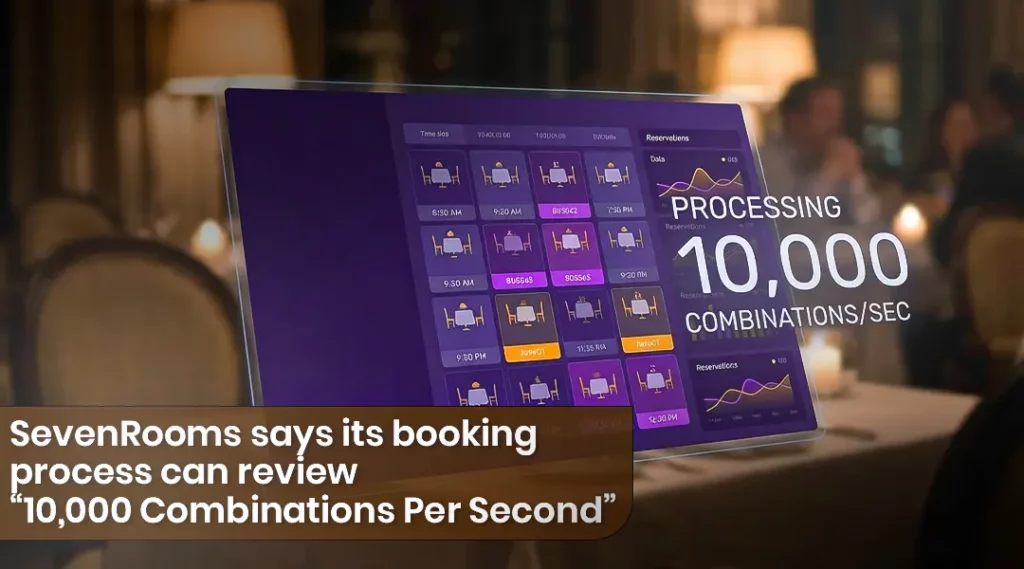
Platforms like SevenRooms often highlight performance metrics to show how advanced their systems are. One of the most talked-about claims is that their booking process can review “10,000 combinations per second” to find the best seat for every guest.
It sounds impressive. Speed suggests intelligence. More combinations suggest better outcomes. But in restaurant operations, the real question is simple:
Does that number actually help when a guest tries to book?
What “10,000 Combinations Per Second” Really Means
In a reservation system, combinations refer to different ways tables can be arranged to fit bookings. The system evaluates possible table groupings based on size, time, and availability.
On paper, checking thousands of combinations per second looks like strong optimization. It suggests the system is exploring many options to find the best fit.
However, this only works within the limits of the model the system uses. If the model itself is restricted, then evaluating more combinations does not improve the outcome. It only speeds up decisions inside a fixed structure.
Why Restaurant Booking Optimization Is a Hard Problem
Restaurant booking is not a simple matching task. It is a form of combinatorial optimization, where the number of possible arrangements grows rapidly as bookings increase. This problem is widely known as an NP-hard problem. As more bookings come in, the number of possible layouts becomes too large to evaluate fully in real time.
Because of this, most reservation systems rely on shortcuts. They reduce the number of possibilities by applying fixed rules. This makes the system faster, but it also limits what it can achieve.
The result is a system that appears efficient but cannot always find the best outcome.
The Real Limitation: Static Table-Based Systems
Most booking platforms, including SevenRooms, operate on a table-based model. Tables are treated as fixed units with predefined combinations.
This creates two important limitations.
First, the system does not understand the full space of the restaurant. It does not see how tables can be moved, combined, or adjusted beyond predefined setups. Even when physical space exists, the system may not be able to use it. Second, once bookings are placed, they remain fixed. The system does not re-evaluate earlier decisions when a new request arrives. It only checks what is left.
As occupancy increases, flexibility drops. The system starts rejecting bookings earlier than it should.
Why Booking Systems Show “No Availability” Too Early
Many restaurants face the same issue. The dining room is not full, but the booking widget shows no availability.
This happens because the system cannot fit a new request into its predefined structure. It does not mean space is unavailable. It means the system cannot rearrange what already exists. From the guest’s perspective, the result is clear. They try to book, see no availability, and move on.
From the restaurant’s perspective, this becomes lost demand that is never recorded.
Does Evaluating More Combinations Actually Help?
This is where the “10,000 combinations” claim becomes less meaningful. The system is still working within a fixed table layout and fixed bookings. It is not exploring all real possibilities. It is only testing variations that fit within its constraints.
So even if it evaluates thousands of combinations per second, reservation system reject a booking that could have been accepted with a different arrangement.
Speed does not solve the problem if the system cannot consider the right options.
What Real-Time Reservation Optimization Should Look Like
Real optimization happens at the moment a booking request is received.
At that point, the system should evaluate the entire dining room, not just what remains unused. It should consider whether existing bookings and layouts can be adjusted to create space.
This requires a different approach. Instead of treating tables as fixed objects, the system must understand the restaurant as a dynamic space that changes over time. It must be able to re-evaluate previous allocations and adjust them when needed.
That is how a booking system moves from passive acceptance to active decision-making.
Static vs Dynamic Allocation in Practice
In a static system, the process is straightforward. A new booking request comes in. The system checks if it fits into the existing setup. If it does not, the booking is rejected.
In a dynamic AI reservation system like WizButler, the process works differently. A new request triggers a full evaluation of the current state. The system considers moving tables and adjusting existing bookings to make space.
This happens in real time, at the moment of decision. The difference is not in speed. It is in the ability to act on complete information.
The Real Cost of Reservation Rejections
This is not just a technical issue. It directly affects revenue.
Many restaurants begin to reject bookings when they are only around 60 to 65 percent full. The system signals “no availability” even though capacity still exists.
Over time, this leads to consistent lost bookings. Guests who cannot book online rarely try again. They choose another venue. These missed opportunities do not appear in reports. They are invisible losses.
Why Staff Still Rearrange Bookings Manually
In many restaurants, staff regularly adjust bookings by hand. They move tables, shift timings, and try to fit in additional guests.
This behaviour shows a gap in the system. If the software handled optimization properly, manual intervention would not be necessary.
Instead, staff step in to solve a problem the system cannot handle on its own.
A Different Approach to Booking Optimization
WizButler approaches this problem differently. It does not rely on fixed table combinations.
The AI reservation system evaluates bookings in real time using a complete view of space and time. When a new request arrives, it can adjust existing allocations and layouts to create the best possible outcome.
This allows more bookings to be accepted without overbooking or manual intervention.
The focus is not on how many combinations are checked. It is on whether the system can make the right decision when it matters.
Final Thought
“10,000 combinations per second” sounds like progress. It suggests speed and scale.
But restaurant booking is not only about how fast a system can evaluate options. It is about whether those options reflect real conditions. If a system cannot adapt to the actual space of the restaurant and cannot re-evaluate bookings in real time, then higher computation does not lead to better results.
For restaurants, the impact is simple. More rejections mean fewer guests and lower revenue. The real measure of a booking system is not how many combinations it can process. It is how many bookings it can accept.
