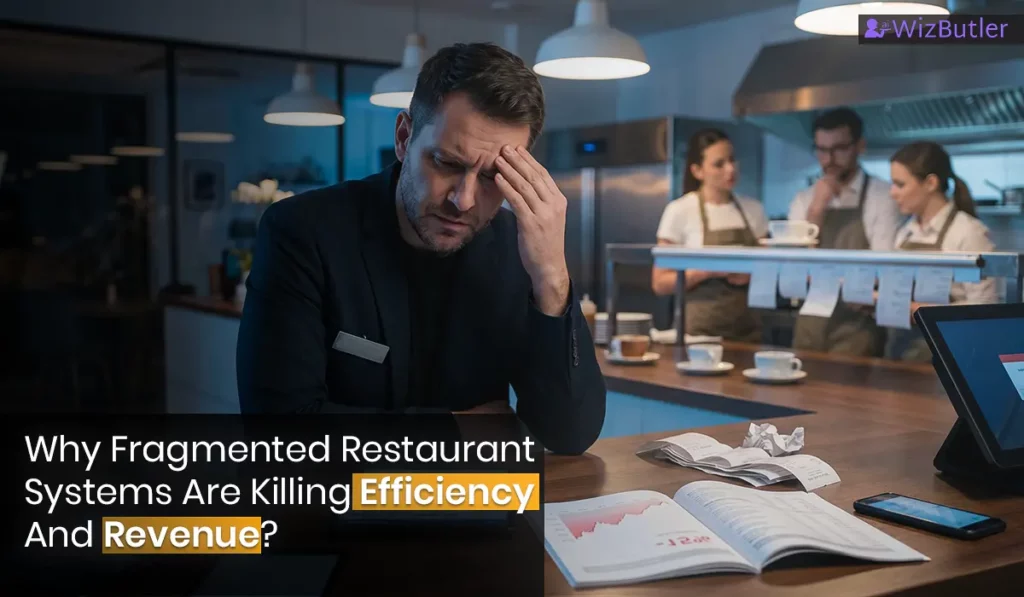
Most restaurants don’t have a people problem. They have a system problem.
Behind the scenes of many venues is a web of disconnected tools trying to work together — and failing. And that fragmentation is quietly killing efficiency, accuracy, and revenue.
The Hidden Problem: Fragmented Systems in Restaurants
Today’s restaurants typically operate with multiple systems:
- booking systems
- POS systems
- function and event platforms
- ordering systems
- CRM, membership and marketing tools
Each one serves a purpose. But none of them truly work as one.
Disconnected Systems Create Operational Gaps
When systems are not unified:
- data lives in multiple places
- information becomes inconsistent
- staff must manually bridge the gaps
This leads to a common but costly reality:
Your systems don’t talk to each other — your staff does.
Why Integration Doesn’t Solve the Problem
Many vendors claim:
“We integrate with everything.”
But integration is not the same as unification.
The Illusion of Integration
Integrations often mean:
- partial data sharing
- delayed syncing
- duplicated information
- mismatched logic between systems
This creates restaurant software integration issues such as:
- incorrect booking data
- inconsistent customer profiles
- reporting discrepancies
- operational delays
The Cost of Disconnected POS Systems
One of the biggest pain points is the disconnected POS system.
Most POS systems are:
- transaction-focused
- not customer-aware
- not booking-aware
What This Means in Practice
- prepayments don’t align with orders
- customer data is not unified
- manual reconciliation is required
- reporting is fragmented
Instead of clarity, operators face confusion.
Instead of automation, they face manual work.
Why Staff Become the Glue
When systems don’t work together, staff step in to make them work.
They:
- re-enter data across platforms
- manually reconcile transactions
- adjust bookings and tables
- fix inconsistencies between systems
The Hidden Cost of Manual Work
This results in:
- wasted time
- increased errors
- staff frustration
- reduced focus on customer experience
Your team is no longer focused on hospitality.
They are focused on managing systems.
Fragmentation Leads to Poor Decision-Making
When data is fragmented:
- reports don’t align
- numbers don’t match
- insights are unreliable
No Single Source of Truth
Without a unified system:
- you don’t know which data is correct
- you can’t see the full customer journey
- you can’t make confident decisions
And when decisions are unclear…
Performance suffers.
The Impact on Customer Experience
Fragmented systems don’t just affect operations.
They directly impact guests.
Inconsistent Experiences
Customers experience:
- repeated questions
- lack of recognition
- inconsistent service
- disconnected communication
This breaks personalisation.
And without personalisation…
Loyalty disappears.
Why Fragmentation Blocks Automation
Automation depends on one thing:
Clean, connected data.
Garbage In, Garbage Out
If your systems are fragmented:
- data is incomplete
- data is duplicated
- data is inconsistent
Which means automation:
- cannot function properly
- cannot be trusted
- creates more problems
This is why many so-called resta urant automation platforms fail to deliver real automation.
The Shift to a Unified Restaurant Platform
The solution is not more integrations. It is a unified restaurant platform.
A system where:
- all operations live in one place
- all data comes from one database
- all processes follow one logic
What a Unified System Enables
- a single source of truth
- real-time visibility across all operations
- seamless customer journeys
- accurate reporting
- true automation
One Database. One System. One Reality.
When everything is unified:
- bookings, functions, ordering, Dynamic POS system, and marketing operate as one
- customer data is complete and consistent
- decisions become measurable and reliable
The End of Manual Reconciliation
With a unified system:
- no duplicated data
- no conflicting reports
- no manual fixes
Everything aligns.
From Fragmentation to Control
Fragmented systems create:
- complexity
- inefficiency
- uncertainty
Unified systems create:
- clarity
- control
- confidence
WizButler: A Unified Restaurant Operating System
WizButler is not a collection of integrated tools.
It is a Space & Time Restaurant Revenue Operating System built on:
- one database
- one operating structure
- one source of truth
It connects:
- bookings
- functions and events
- Dynamic ordering system
- Dynamic POS
- customer data
- marketing
Into one seamless system.
Final Thought
If your systems are fragmented…
Your operations are fragmented.
If your data is fragmented…
Your decisions are fragmented.
If your systems don’t work together…
Your team is doing the work your system should be doing.
Apply for a Space & Time Diagnosis
Discover:
- where your systems are breaking down
- how much time is being lost to manual work
- where your data is inconsistent
- how much revenue fragmentation is costing you
Apply for a Space & Time Diagnosis and experience what a unified system can do.