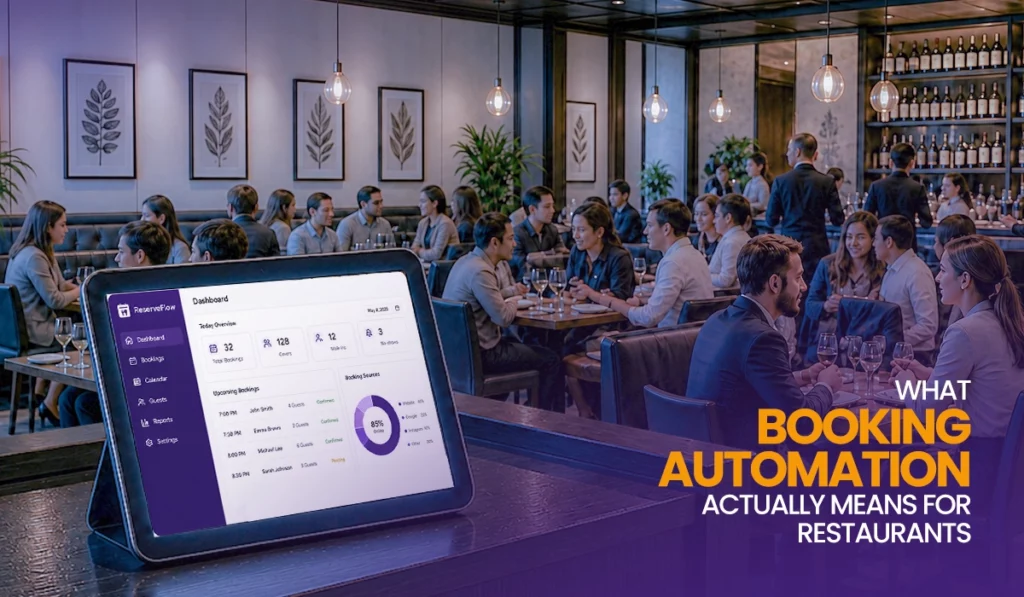
Booking automation is not just about online reservations. That is the entry point, but it is far from the whole picture.
True booking automation means every step of the reservation journey runs without requiring manual input from your team. A guest finds your venue, selects a time, receives instant confirmation, gets reminders at the right intervals, and arrives to a table that has already been optimised for their group size and your floor’s capacity that evening without the need for reservations staff.
Behind the scenes, automation means a system that is fully configurable to seamlessly support with your venue’s brand, positioning and style of service with your booking data connected to a dynamic real-time system with a dynamic table rearranging system to optimise and maximise both your normal restaurant bookings and function bookings, seamlessly allows for pre-orders, in-service orders, with your POS system in complete sync within a unified customer data platform for complete analytics, segmentation and marketing. Such that, when anything changes anywhere in your system all other necessary parts of the system are seamlessly updated.
The distinction matters because most restaurants have automated just the taking of the booking, and the rest is separate, unrelated systems or systems that cannot be fully integrated. The gaps between these disconnected steps are where operational problems live.
Why Static Systems Create Dynamic Problems
Every restaurant is a dynamic environment. Guest group sizes change. Bookings come in at uneven intervals. A function booking changes the whole floor configuration for the evening. A late cancellation opens up capacity that could be filled.
Static booking systems were not designed for this. They treat your restaurant as a fixed set of tables, capacities, and time slots. When reality does not match the static model, the system breaks down, and your staff absorbs the difference through manual workarounds.
This is the core problem WizButler was built to solve. The philosophy behind the platform starts with a different definition of what a restaurant is. Not a set of tables, but a physical space defined by People, Intent, Actions, Space, and Time.
When your booking system is built around that model, the floor plan becomes a live asset. Table configurations adjust as bookings come in. Functions and regular reservations share one unified view. Capacity is maximised based on real demand, not a static buffer.
What an Integrated Booking Operations System Does Differently
A booking tool takes reservations. A booking operations system — what’s increasingly called restaurant operations software — connects those reservations to everything that happens after them for a complete operating system.
Guest profiles and intent
When a guest books through a properly integrated system, their preferences, visit history, dietary requirements, and occasion details travel with the booking. The front-of-house team sees who is coming and why before the shift starts. This is not a nice extra. It is the difference between a restaurant that feels personal and one that feels transactional.
Real-time floor management
As bookings change throughout the day, the floor plan should respond automatically. If a group reduces in size, the configuration adjusts. If a cancellation opens up a two-hour window, the system identifies whether it can be filled and activates the waitlist.
This is where significant revenue recovery happens. Venues using WizButler’s dynamic floor plan management regularly fill capacity that legacy systems would have blocked off entirely.
Automated communication sequences
The most effective reminder sequence for reducing no-shows is a three-touch approach. An instant confirmation when the booking is made. A reminder the day before. A same-day message a few hours before the reservation. Each message should include everything the guest needs and a clear way to confirm, reschedule, or cancel. Research consistently shows automated booking reminders reduce no-shows by 30 to 40 percent.
A well-timed cancellation is not a loss. It is an opportunity to fill the slot from your waitlist. The system should handle that automatically.
Functions and events on one platform
Function bookings are operationally different from regular reservations. Tables may not exist in the traditional sense. Deposit collection, run sheets, catering options, and floor configurations all shift. Running functions on a separate system from regular bookings creates split operations and incomplete information.
When both live in one platform with one database, the operations picture is complete. Your manager is not reconciling two systems at 9 AM. They are looking at one dashboard and running a service.
Payment and deposit automation
Collecting deposits for bookings reduces no-shows further and protects revenue for peak services. Automated deposit collection, tied directly to the booking confirmation flow, removes friction and eliminates the manual follow-up that most venues rely on.
Voice AI Booking Capture
Voice AI for booking systems is simply a layer connecting voice to an underlying booking system. As such, Voice AI does not change your booking system or add additional AI allocation capabilities to your booking system; it merely acts as the integration mechanism or connection that allows a person’s voice to connect with your booking system.
Therefore, when selecting a Voice AI system the core and critical part of that Voice AI system is what is the underlying booking system that it is connected to and then ensuring the Voice AI system provides the features required from a booking system like customer recognition, the right tone, branding and seamless interaction.
The Integration Problem That Most Platforms Gloss Over
The problem that causes the integration disconnect that does not get discussed enough is that while all restaurant systems use table frameworks, those table frameworks are very different as they define the concept of a “table” in different ways that cannot be seamlessly reconciled with one another.
A booking system thinks a table is a container comprising reservation and guest details. An ordering system thinks a table is an interaction session. While a POS thinks a table is a container to process transactions. A function system may not think about tables at all when the event is a standing cocktail reception. The only way to overcome these problems is to add another integration system and layer, which adds more costs and overhead, and it also needs to be monitored, as changes to the underlying systems may break the mapping used in the integration layer.
This is why restaurants end up with multiple systems that cannot share data seamlessly. The booking data does not flow to the POS. The function bookings do not necessarily appear on the floor plan. The CRM does not know what customers are purchasing what items. End-of-night reconciliation takes over an hour.
WizButler’s architecture is designed around SPACE, and it is this fundamental difference that allows “tables” to be defined properly between the different systems for the creation of seamless operations within a single unified database so all the different operational restaurant systems can speak the same language. One database. One operating system. Seamless operations.
Key Things to Look for in a Booking Automation System
If you are evaluating booking platforms for your venue — from restaurant POS integration to floor-plan flexibility — these are the questions worth asking.
Does the system work from a static table map or a dynamic floor plan?
A static floor plan will always cap your capacity below what your venue can actually hold.
Are bookings, functions, ordering, and POS on one database or separate tools patched together?
Separate tools mean manual reconciliation and information gaps.
Does the platform capture guest intent and preferences, or just names and times?
Guest context is what enables personalisation at scale.
How does the system handle no-shows? Is there an automated reminder and deposit collection flow, or does that still rely on your staff?
What does reconciliation look like at the end of the night? One report from one database, or a manual process across three separate systems?
A Note on Operations vs. Technology
Booking automation is not a technology project. It is an operations decision.
The technology only works when the underlying operations model is sound. That means clear policies on deposits and cancellations. A defined reminder sequence. A floor plan that reflects how your team actually uses the space. A guest database that is kept current. Staff who understand what the system does and trust it.
WizButler is built with this in mind. The platform is designed around how restaurants actually operate, not around how software developers imagine they operate. The Space and Time framework at the core of the platform reflects real operational logic: your venue is a physical space, your guests have intent, and your operations need to respond to both in real-time.
Summary
Restaurants that treat booking as a separate activity from operations will always be leaving capacity and revenue behind. Booking is the beginning of the guest experience and the foundation of every operational decision that follows.
When booking automation is properly integrated, the whole operation runs from a shared understanding of who is coming, when, why, and how much space they need. Every system speaks to every other system. Your team spends their time on service, not on admin.
That is what WizButler is built to do.
If you want to see what this looks like for your Australian venue specifically, book a demo with the WizButler team or run your numbers through the restaurant revenue loss calculator to understand what your current system may be costing you.
WizButler is the all-in-one AI restaurant revenue operating system for restaurants across Australia. It replaces static, fragmented booking tools with a real-time Space and Time platform that handles reservations, functions, ordering, POS, and guest operations from one database. For venues currently comparing fixed-table platforms like SevenRooms, this is the core difference — WizButler is built around space, not static tables.
Related reading from WizButler: